Why AI Tools Won't Replace Your Marketing Strategy (And What Will)
There's a version of the AI conversation that goes like this: plug your business into a few tools, let the algorithms figure out your messaging, and watch the leads roll in. No strategy required. No agency needed. Just automation and results.
That version is wrong. And a lot of small business owners are learning it the hard way. We're not here to be anti-AI — we use it every day. But we are here to be honest about what it actually does, what it doesn't do, and why the businesses that are winning in 2026 aren't the ones who replaced their strategy with tools. They're the ones who built a smart strategy and then used the tools to execute it faster.


What AI Marketing Tools Are Actually Good At
Let's give credit where it's due. AI tools are genuinely impressive at a narrow set of tasks.
Speed and scale. Need 20 variations of an ad headline? Done in seconds. Want to repurpose a blog post into social captions, an email, and a script? AI can do a first pass in minutes, not hours. For execution-heavy work, this is a real advantage.
Pattern recognition. AI tools can analyze performance data at a scale no human team can match. They can spot which subject lines get opened, which ad creative drives clicks, and which posting times correlate with engagement — across thousands of data points, continuously.
First drafts. A blank page is expensive. AI is good at getting something on the page that you can react to, edit, and shape into something that actually reflects your brand.
These are real capabilities. The problem is that most business owners are sold on these capabilities as if they're the whole job. They're not. They're the easy part.
What AI Consistently Gets Wrong
Here's where it falls apart. AI tools have no idea who you are, why your customers trust you, or what makes your business different from the 12 competitors a customer could choose instead.
Brand nuance is invisible to AI. Your tone isn't just "friendly" or "professional" — it's the specific way your team talks to customers, the inside references that resonate with your community, the things you never say because they'd feel off. AI has no access to any of that. It generates content that sounds plausible. Plausible isn't the same as true to your brand.
Audience empathy requires actual humans. AI learns from patterns, not from people. It can tell you that a certain message performed well historically — it cannot tell you why a particular customer segment feels underserved right now, or how an emerging local trend is shifting what your clients actually care about. That requires listening, judgment, and relationships.
Long-term positioning is invisible to it. AI optimizes for measurable short-term signals. It has no concept of brand equity, reputation, or the patient work of owning a market position over time. Left to its own devices, it will optimize you toward whatever is working right now — even if that conflicts with where you're trying to be in three years.
The result? AI-generated marketing that's technically competent and strategically hollow. Campaigns that get impressions but don't convert. Content that sounds like everyone else in your category.

What "Strategy" Actually Means (And Why It's the Multiplier)
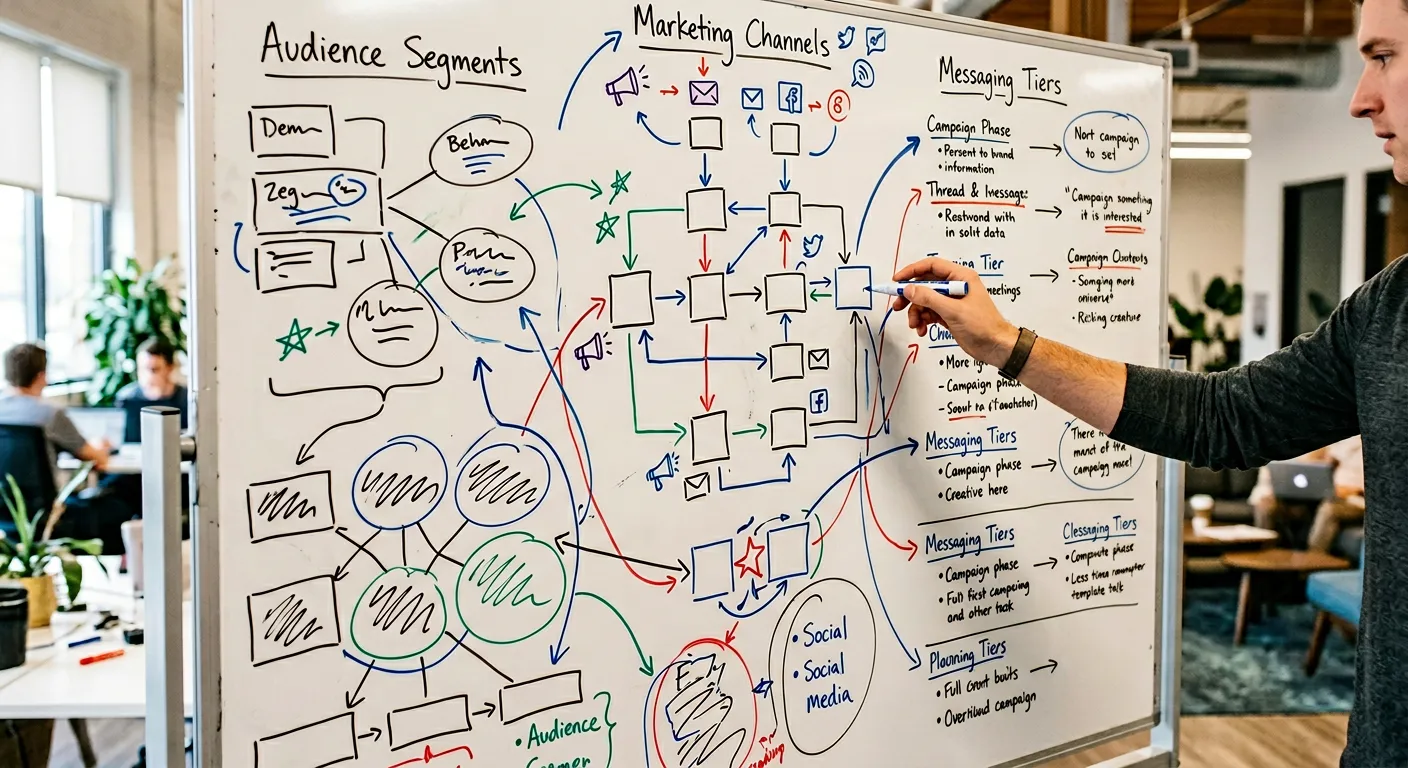
The word strategy gets overused, so let's be specific. Marketing strategy answers four questions before you spend a single dollar:
- Who exactly are we trying to reach? Not "small business owners" — the specific person, with specific problems, who is already looking for what you offer.
- What do we want them to believe about us that they don't believe yet?
- What's the one thing we need to say to shift that belief?
- Where and how do we show up to say it?
AI can help you execute on the answers. It cannot generate the answers. Those come from market research, customer conversations, competitive analysis, and the kind of hard thinking that forces you to make choices — including what you're not going to do.
Strategy is the multiplier. Ten times the execution on the wrong strategy is ten times the wasted budget. The right strategy with smart, AI-assisted execution is where the leverage actually lives.
How Smart Businesses Use AI Within a Strategy
The businesses getting real results from AI in 2026 are using it as a production accelerator inside a human-led strategic framework. Here's what that looks like in practice:
- Strategy is set by people. Target audience, core message, brand voice, positioning, and channel priorities are defined by a team that understands the business.
- AI handles volume. Once the strategy and creative direction are locked, AI scales the execution — more content, faster testing, broader reach, consistent optimization.
- Humans interpret the data. AI surfaces the numbers. Experienced marketers decide what those numbers mean, what to change, and what to stay the course on.
- Brand review is non-negotiable. Every AI output gets a human pass before it goes live. Not because AI always gets it wrong — because you can't afford the times it does.
This isn't a complicated framework. It's just discipline. And most small businesses don't have a strategic layer in place yet — which means their AI tools are generating a lot of activity and very little traction.

The Real Competitive Advantage in 2026
The marketing landscape right now is full of businesses producing more content than ever with AI tools. Most of it looks the same. It sounds the same. It converts the same — which is to say, poorly.
The businesses that stand out aren't the ones with the most tools. They're the ones with the clearest strategy, the most authentic brand voice, and the discipline to execute consistently against both. That's the work HiveMinds does. We help small businesses build the strategic foundation that makes every tool — AI or otherwise — actually work.
Ready to Build Something That Actually Works?
Book a free strategy session with the HiveMinds team. We'll take a look at where you are, where you want to go, and what it would take to get there — with or without the robots.
Book Your Free Strategy Session